Simple setup versus explicit control
Guided software can reduce setup friction. It should not hide the material identity, settings, inspection conditions, or reason a recipe is accepted.
INNOVATION WITH AN AUDIT TRAIL
Innovation is treated here as a controlled learning cycle. A new source, optic, accessory, material, or software path becomes useful only when the result can be described, tested, challenged, and repeated. The framework below uses the compact data structure assigned by the manifest while keeping every topic focused on product and workflow verification.
VALIDATION LEDGER
The values are process records to capture, not performance values asserted for every model. Replace planning ranges with the current datasheet and test results for the exact configuration.
| Gate | Inputs to freeze | Evidence to retain | Release condition |
|---|---|---|---|
| 01 / Feasibility | Source family, work area, material identity, thickness, finish, enclosure, extraction | Supplier document, model document, hazard screen, labeled material coupon | No unresolved material prohibition; test plan approved by the responsible operator |
| 02 / Process window | Focus method, power, speed, passes, assist, fixture, artwork revision | Setting matrix, photographs, front/back inspection, rejected-condition notes | At least one repeatable window meets a written visual or dimensional rule |
| 03 / Repeatability | Machine condition, material batch, loading method, operator sequence, cleaning | Three separated repetitions, inspection results, deviation log, elapsed handling time | Variation remains inside the stated acceptance boundary under the same test method |
| 04 / Change control | New batch, source, optic, accessory, software, fixture, exhaust, or acceptance rule | Change note, risk review, targeted retest, approved revision and archive | The altered workflow has evidence proportional to the change; old recipes are not silently reused |
Guided software can reduce setup friction. It should not hide the material identity, settings, inspection conditions, or reason a recipe is accepted.
Many quick experiments help exploration, while a production decision needs isolated variables and repeated coupons. The two modes serve different purposes.
A multi-process portfolio expands options, but source-material interaction, fumes, reflectivity, fit-up, and end-use requirements still narrow each approved route.
RELEASE PACKET
The checklist deliberately avoids generic badges. It asks for the specific records a buyer, lab, classroom, or production lead can examine.
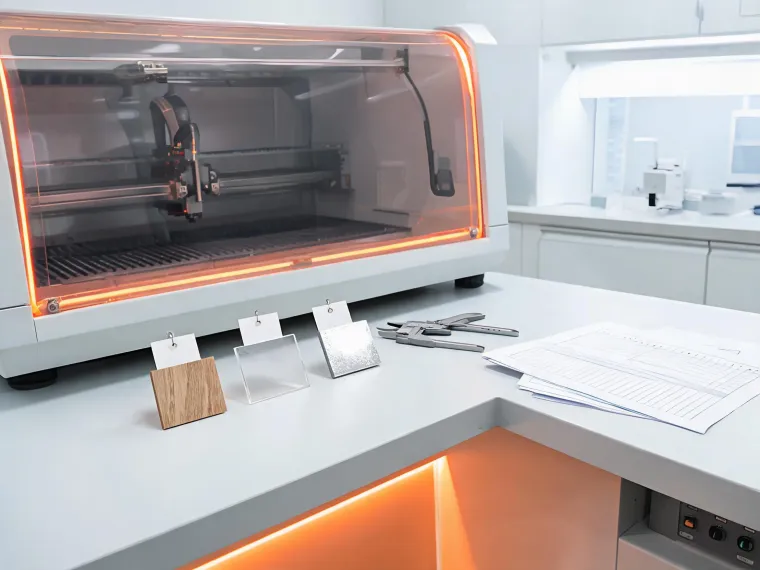
Model, region, source, accessory, firmware or software revision where relevant, and the date the supporting document was retrieved.
Material batch, fixture, focus method, extraction state, ambient considerations, operator, and the inspection lighting or measurement tool.
A step sequence, setting matrix, labeled coupons, failed examples, photographs, and at least three repetitions of the candidate condition.
Materials not evaluated, outcomes not measured, regional requirements not reviewed, maintenance dependencies, and events that trigger retesting.
Start with one workpiece, one desired outcome, and one inspection rule.