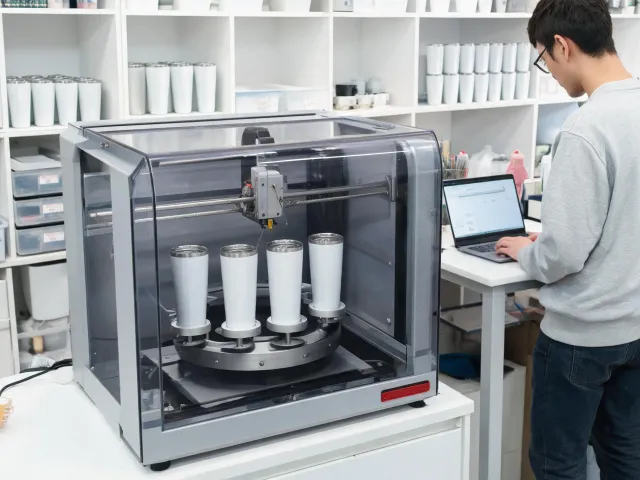
The question is repeatability, not one beautiful sample
Artwork setup, rotary alignment, coating variation, cleaning, and fixture loading can dominate batch quality. A useful route begins with a labeled first article, then repeats the same recipe on separate pieces from the intended lot. Inspect contrast, position, surface damage, and residue under one lighting setup.
Limit: a recipe from one coated item does not automatically transfer to another supplier, color, geometry, or coating batch.
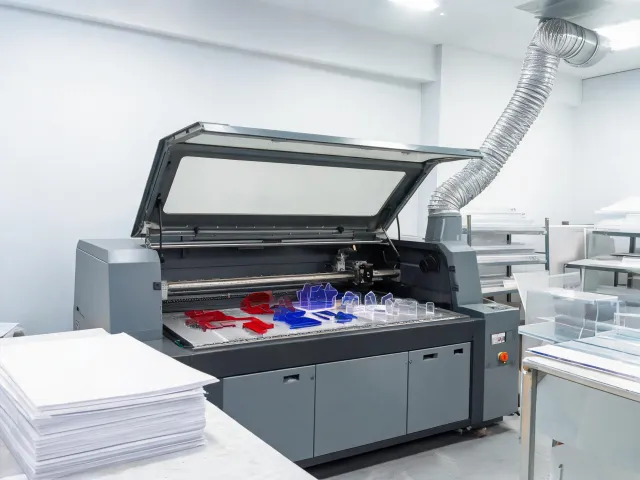
Edge appearance competes with speed and heat
Acrylic type, masking, thickness, exhaust, focus, and pass strategy affect edge finish and smoke deposition. Compare a faster pass with a slower pass at equivalent inspection conditions; record whether either route requires secondary finishing. Nesting yield and handling time belong beside cutting time in the cost discussion.
Limit: not every transparent sheet is laser-compatible acrylic. Identify the polymer and never infer safety from appearance.
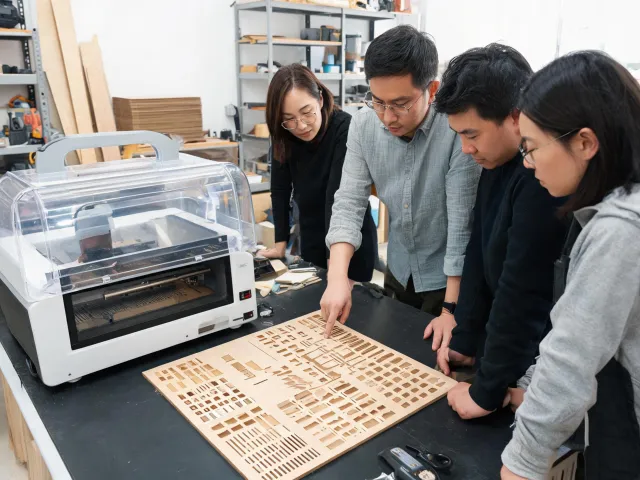
Access control is part of the curriculum
A classroom workflow needs an approved-material list, named supervisors, pre-use checks, job review, machine occupancy rules, cleanup, and an incident path. A matrix test can teach cause and effect: vary one setting, label each coupon, and discuss kerf, heat staining, incomplete cuts, and why some materials are excluded.
Limit: training content does not replace local institutional policy, risk assessment, ventilation review, or the machine manufacturer’s instructions.

Iteration speed needs revision control
Fast geometry changes are valuable when file revision, material lot, settings, and inspection notes stay connected. Record whether the purpose is dimensional fit, visual presentation, or functional use. A prototype approved for assembly fit may still be unsuitable for heat, load, food contact, or long-term service.
Limit: laser-made prototypes do not establish production material compliance or end-use certification.
Method trade-offs to test, not debate abstractly
| Decision | Route A | Route B | Evidence |
|---|---|---|---|
| One pass or multiple | Less handling | Can distribute heat differently | Edge, back face, time, repeat count |
| Masking or exposed surface | May reduce deposits | Removes masking step | Residue, cleanup, surface finish |
| Open loading or enclosure | Flexible workpiece access | Improved containment potential | Risk assessment, extraction, workflow |